(From 2015)
FROM THE GOSPEL OF LAMPERTI:
“I have observed how little attention is paid nowadays to individualizing. No two persons are exactly alike, much less any two pupils, In vocal teaching, especially, it does great mischief to try to make one shoe fit every foot.” (Lamperti 1839-1910)
I was a pain in the butt voice student, especially with my father as my teacher. Ok, ok, so parents teaching their kid is a hard dynamic but I didn’t help the process any. My iron will that helps me to achieve as well as helps me to clash with the world around me has been present since middle school as much as I tried to mask it with my fear. I was able to build solid pedagogic singing tools from my various voice teachers. Not all from one but a healthy doctor bag that I turn to often from a host of gifted communicators. My stubbornness….I mean….strong will, that I inherited (probably mostly from my German grandmother,) is what has kept me at 46 still pursuing this competitive, demoralizing, political, amoral, ravishing, fulfilling, centering, and spiritual singing career, albeit part time. When I work with singers privately of all ages, I find that they share some of my same barricades which obstructs their vocal freedom. It has been such a blessing to work with these singers and take a tandem jaunt on their singing road. And, I believe it is not all about voice category. Fach, smach. Sure, there is a lot to be said for working with your voice type but finding your voice takes a lot more than specificity of those who dwell in the same vicinity. It is amazing how certain things pop up when least expected with students from aged 13 to 70. Many of my singers combat similar vocal gremlins as I did and still do. So here goes: the top seven roadblocks that classical singers put on their singing path.
#1 MAKE ME BARBRA, DARN IT!
STUDENT: I want my voice to sound like….. (Fill in your flavor) And PS: I don’t sing high.
A voice is unique to us alone. We can train and blend the registers, find our core, and extend our range BUT, as much as I would love not to have an apple body shape, there is only so much you can do within in reason. Sing with your voice and communicate what makes you tick. High priest and priestesses are we. Sing your vocal map. We are athletes. Some people actually have to find their upper register, it doesn’t emerge in 7th grade like Janet Perryman, ready for her to sing “Caro Nome” at 12. Your tessitura will evolve and you will find pieces more suited to your abilities. But deciding that you can’t sing in a certain area is like a pianist saying, I don’t play the top 44 keys.
“And all meet in singing, which braids together the different knowings into a wide and subtle music, the music of living.”
#2 I PRACTICED FOR 4 HOURS!
STUDENT: That can’t be right because it feels like I am not doing anything.
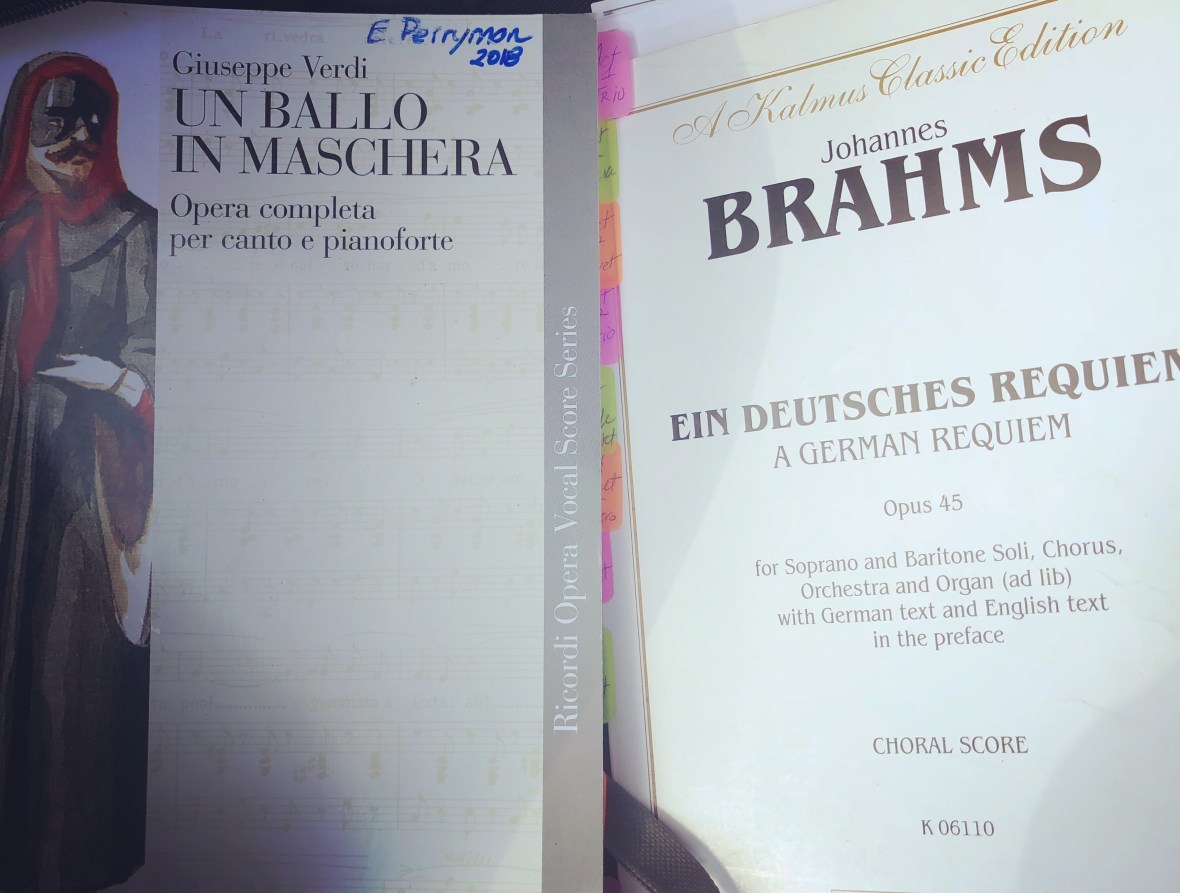
The coveted type A work ethic is great when learning music, mastering languages and memorizing scores but when trying to release your most organic technique, it can create major vocal blockades that worsen with age. Letting go is the most scary and wonderful thing at the same time. It is a great high when vocal freedom makes a cameo appearance. I have found that each singer has one type of natural ease that they do without an issue. Mine is the blend that I have always had around middle C. The end of Verdi’s Libera Me in the Requiem is always so fun to sing. Being a soprano with this ease helps me with the big rep. For some of my students it is a certain vowel or fioratura. I am convinced everyone has something.
“Keep a green tree in your heart and perhaps a singing bird will come.” ~Chinese Proverb
#3 IT’S TOO TIME SQUARE!
STUDENT: That is too forward and Broadway-sounding. That doesn’t sound like what an opera singer is supposed to sound like…..
There are many lessons that we can learn from each other in the performing arts. I don’t believe in a hierarchy of singing types. Of course if you have a queen of the night with smoking high f on a concert, you can pack up your Count, Nemorino, Mimi, or Charlotte and grab a taxi, it is good night John Boy. Perhaps there can be a scale with performers who are most able to connect with the audience. I have always admired how directly Broadway singers produce their sound. I have never been a good mimic which was great for my growth because I didn’t copy other singers which can be common problem. In my own experience, I have tried to “make sound” far too often. It was only when I found the ease of breath, articulating with my lips teeth and tongue naturally, that my free sound followed. “How we sound is none of our business” said my fabulous Bayou voice teacher guru, Patricia O’Neill. She was right.
“You don’t love someone for their looks, or their clothes, or for their fancy car, but because they sing a song only you can hear. ~Author Unknown
#4 STAND UP STRAIGHT AND TANK UP
STUDENT: I need to sing with proper breath support and good posture.
There is pedagogy to learn about singer’s breathing. And you won’t always get to sing vertically. Could you sing on the floor? I think David L. Jones is one of the best contemporary articulators of the breathing technique that I have seen. When support becomes muscular, contrived, and off the body, it is worse to use faulty breath technique than to not take a breath. When I ask students their concept of breathing, most don’t have too many opinions. And the ones that are support and posture disciples usually have significant tension issues. In my journey, Alexander technique has helped me with finding healthy posture and breathing. Finding my core sound connected with the balance of breath has helped me. Unlearning the drop your jaw and stand up (unnaturally) straight chorus commands of my youth has helped me. Some voices are so balanced that they can sing without a real cognizance of breath support. But there is a method and it must be connected to your authentic sound production for the most enduring phrases. And then, some people just have thicker cords that are harder to vibrate and are a lifelong challenge.
“Breath is Spirit. The act of breathing is Living.” ~Author Unknown
#5 SING OUT LOUISE! DROP THAT JAW AND OPEN WIDE!
STUDENT: I don’t sound loud enough. I need to sing with a lot more air and open more.
There is a reason why the baby cry is so audible. Babies don’t have to strain to get a tired parent’s attention. They are making sound completely honestly without any “supposed to” rhethoric floating in their memory bank. For most singers, singing outside of what the body reveals only gives recipe for vocal grief. Too bad we lose so much that is amazingly natural from our early years. The best bet is to “find your frequency; use your lips, face, jaw and mouth as ‘sound enhancers’ or resonators. Hook the sound and body together as you sing.” So many singers have, however unconscious, belligerent tongues and jaws that impede the sound. These tensions can be so familiar that singers aren’t even aware. It may take vocal cracking to show the seriousness of the tension. At one time, holding the tongue or jaw may have seemed have helped to make sound and it stuck. Stripping these layers will help exponentially with vocal production. Be kind with your dynamic range. Your dynamics will not be the same as others. Don’t drive yourself batty trying to sing the same as your neighbor. Dynamic “keeping up with the jones” is a no win situation. My pianissimo has its own personality and isn’t always useable in delicate choral settings. Hence, my big girl pants soprano 2 placement…. After undergrad is when you realize that “soprano 1” doesn’t mean better….
“The Baby Cry with the frequency range of about 2800 to 3200 Hz is the easiest one for us to hear.”
#6 A…E…A….E…I…O…U..AND SOMETIMES Y?
STUDENT: It’s all about the vowels, consonants are less important.
One of my most treasured tools was the work that I did on consonants with Mark A. Thomsen when my voice was in its Prozac phase of my late 20s. Vowels were always the mantra but finding the consonant on the pitch, articulating on the breath, connecting vowels and consonant on the legato was an effective exorcism on my scared little demons. It helped me actually start a path of capturing a respectable legato. I still have more miles to go. I happen to favor the unvoiced consonants in my technique work but some of my students like the voiced consonants. It is very individual and oh so helpful when you can use your favorite consonant to ease into the most efficient vocal production.
“The human voice has the capacity–as does no other musical instrument–to express not only music but also drama and literature. For this reason, study of the vocal instrument becomes not just technical and mechanical but also human. To be sure, the vocal cords function on a subconscious level and are best controlled indirectly, often through imagery. It is this fact that makes vocal training highly intimate and convinces other musicians that the personal nature of vocal pedagogy is an object of ridicule. (“What does that mean: send it up and over?” non-singers say with heavy sarcasm. “Send what? Overwhere?”)
#7 DANGER, WILL ROBINSON
Disclaimer-I sincerely apologize if I offend anyone but this perspective gets my goat…
STUDENT: TV singing shows that showcase singers without training are not worth watching. They don’t know how to sing and are beneath our art form.
Just as I think that those who judge children’s choral competitions are not really living in reality (many chorus students come before school and give up RECESS;) I also think that classical singers who snub singing shows are missing out. No, collegiate judge, I am not going to give my public school choir the most head voiced piece about butterfly and snails. I like NOT getting the stink eye from the boys in my choir and well, having them actually show up to rehearsal and like it. Boy soprano high note contests rule. Yes, there is technique to learn but the reality is that some people are just born able to make a beautiful sound that connects. And, enjoying performing, even if the piano was more mezzo and the ending consonants were a little unclear, is very important. Less schooled performers may not have the best vowels, and God forbid, breathe too often, but we would lose so many command performances if we only acknowledged the erudite artist. I am sure that vocal pedagogs could find plenty wrong with Whitney Houston’s Star Spangled Banner but I count that as one the best renditions that holds up to the test of time. I think our mission, especially as specialized singers, is to bring the sheer joy and wonderful life skill of music to others. It is not for everyone to strive to be Pavarotti. If Josh Groban’s occasionally brittle baritone can give solace to someone grieving, our job has been done.
“An intellectual snob is someone who can listen to the William Tell Overture and not think of The Lone Ranger. ” ― Dan Rather
#akintsucrooner