Pure Vowel Elixir 

Dear American English Classical singers, if you can answer yes to any of the questions below, you, too, may be helped by the power of fruit….

1. Do find it challenging to learn other languages, especially the pure vowel ones?

2. Do you speak with an thick hometown vernacular?

3. Do you find yourself saying the same vowel many different ways?

4. Does trying to neutralize and purely pronounce vowels (despite what your natural language would have you do) give you fits however beautiful when refined?

Fret no more, dear songbirds. I have found an easy remedy to help cure your murky vowel woes. 

As I continue to work on establishing idiomatic Italian diction, I stumbled on a greatly helpful handy dandy word.  

Say to yourself “banana.”

Did you say boe nae nuh?

I work with a wonderful vocal coach, Giovanni Longo. His native language is Italian. When he pronounces this word, he says: bah nah nah. 

Ok, I giggle a bit when he says it. 

But this shows in a nutshell, the purity of the Italian language. It is a little window into how American speakers can more easily access an Italian tongue. 

Listen to the Italian greats sing musical theater. That is another great insight (albeit somewhat funny) into the world of pure vowels. 

And the great news is that the world of pure vowels is the singer’s elixir. Bel canto or bust indeed. 

#akintsucrooner

CAUTION TOSS

Teaching one on one is a specialized gift.  I have naturally gravitated towards working with bigger groups in my teaching.  One on one instruction isn’t my first choice but I do enjoy the work I do with my private students and have learned a lot.  So much of private voice teaching involves semantics, approach, and energy before quantitative content can be accessed.  It is a process of peeling back layers of interference and side stepping self created road blocks. And in that vulnerable space, we can easily be trampled and discouraged in the wrong setting.  With tenacity and grit, vocal progress will result from a constructive and nurturing environment.  With this challenging work, involuntary technique will emerge.  Vocal pedagogy is an intricate fine art.  To achieve the best result, we have to throw caution to the wind.

We seek to become proprioceptive.  I began to learn about this concept in graduate school from my gifted LSU and Mannes Alexander Technique teachers.  It has been a real gift over the years in my vocal journey.  Proprioceptive meaning:  the sense of the relative position of one’s own parts of the body and strength of effort being employed in movement.

This body work is essential to finding an integrated, free sound on the breath.  And it is a lifelong process; no finish line to reach.  The physical knowing sustains and informs a healthy singing life.

I learn well with a tactile approach but often encounter students who approach singing in a more cerebral manner.

I am fortunate to work with a talented adult singer who is also a colleague.  She is very bright and conscientious.  My personal “monkey see monkey do” approach (which has actually worked pretty well for me in my vocal journey,) hasn’t always been her forte.  Anymore, she is embracing a more felt technique; not an easy feat.  As we work on ease and less inhibiting, she continues to make strides.  Tonight we had some epic chuckles as we communicated in the vocalizes sans words; just by making strange sounds.  She was able sing with more clarity and register blend.  It was exhilarating for us both.  Her most common observation after the fact have been “it just came out.”

Throwing caution to the wind and becoming proprioceptive in the singing process is daunting.  And as a singer, WE are our instrument so it can be impossible not to take challenges and critiques personally.

Finding ease wherever it lives in your throat, (originally for me it was extreme high and low,) will help to capture the Romanian spirit in your vocal production.  I have witnessed firsthand the tears and joy the freedom brings.  It’s worth the risk.

#akintsucrooner

Genya 3.jpg


PRE-LIFE REQUISITES

Ten areas of study I would mandate in my imaginary pre-life school if I had my druthers (that I work on daily)

IT’S NOT YOU, IT’S ME 101:  Nothing is really ever personal.  Try not to take the perceived bait.  This is less easy on days where your glass is half empty.

UNCONDITIONAL 102: You have to advocate for yourself.  Be your own unconditional support system.

BRAIN BREAK 103:  Gain the powerful tool of taking a break from a charged situation.

CORE 104:  Find out your own spirituality that gives you hope. Be ready for it to be challenged and discarded.

CTRL ALT DELETE 105:  Find a way to be functional when the inevitable unexpected happens.

AND THE UNIVERSE SHALL GUFFAW 106:  Things rarely go as planned.  Expect to be surprised.

GOOD CHEESY HUMOR FOR THE SOUL 108:  Humor NOT cleanliness is next to Godliness.

TOOTHLESS LAMENT 108: Mom was right, floss early and often.  Tooth care is lost on the young.

PASSING ALONG 109:  This too really does pass even though problems can feel insurmountable.

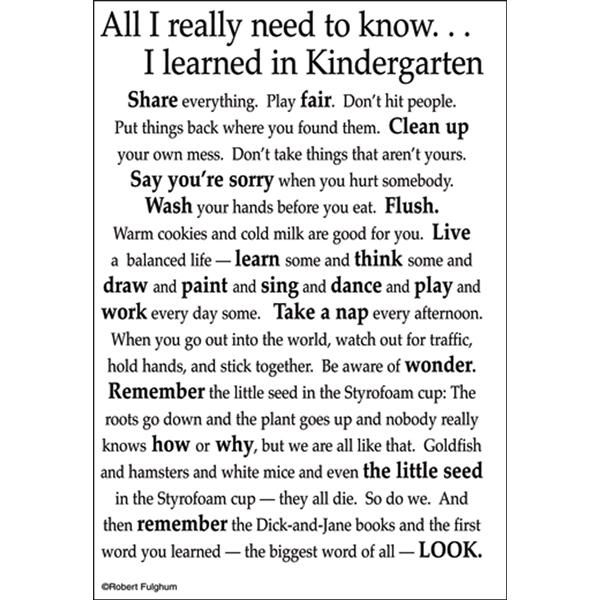
TODAY’S REVELATIONS 110:  Robert Fulghum’s “Everything I know, I learned in kindergarten” is one of the strongest spiritual texts of the modern age.

Fulghum

#akintsucrooner

Battle of the Opera Alpha

By George, Tosca is starting to sink into my bones. Learning her is all about the chase. I think my wooing is starting to work. 

Thoughts today after singing almost the whole role in coaching:

1. If I ever feel needy, I’ll remember that no one is more needy and prone to crazy outbursts like Floria Tosca. Holy chiaroscuro, Batman. 

2. My coach compared the chords on beat one of line one and two to Scarpia’s male part happiness. Lol. 

3. And today’s quote:

Tosca is an Alpha. 

Some partners need that in their partner. 

Ok, maybe I need that too.  #justnyagiermola:-)

Respect

I believe that if someone demands respect of another individual from whom they have never walked in their shoes, they are showing the very disrespect that they demand and rail against. EAP 10.1.17
#akintsucrooner
#bekindforeveryoneyoumeetisfightingahardbattle #empathy

62FE927F-F427-48A0-878E-1FA9B6A8F3C8.jpeg

Stuff that helps me sing….

Professional musicians who lead musical groups can get interesting requests and feedback.  There is a lot of singing language floating around out there spoken by many.  It can be confusing and not terribly easy to understand by civilians.  However well intended, problems can result from implementing various suggestions especially with less advanced singers. From these popular singing adages:  tension and restriction can come over dropping your jaw, lack of breath flow can come from forced singing from the diaphragm, affected timbre can come from excessive pinging into the mask, and back muscle pain can come breathing into your butt (lol.)

And the list goes on….

So from the above requests, my suggestions are below:

1.   What exercise helps with harmonizing?

Harmonic Warmup:

Spell out arpeggiated chord Bass F3 Tenor C4 Alto A 3 Soprano F4

Sing on Mee May Mah Moh Moo

Modulate and module vowels to get blend across the sections

Vowel placement is suited to this exercise as you try to get a homogenized sound


  1. How can we work on major and minor scales?

Pitch Orientation:  (Solfege on diatonic major and minor scales)

Major:  Do re mi fa so la ti do

Minor:  do re me fa so le te do


  1. How do you teach support?

Breathing basic demo:  Take breath in expanding ribs and release on Ch or Sh or FF 5x (hold last one to expel the air) to demonstrate inhalation and exhalation

Breath Support:  Buzz or rr on 1-5-1 for breath support.  Extend scale degrees as ability increases.


  1. How do you explain placing chest, head and nasal cavity and work range?

Range Exercises:

Fah 1358531 or 1358108531 or 81058351 to move air and access low and high registers

Extend by using 5 Italian vowels (fee fay foh fah ah ah fee

This will help singers locate high, middle and low along with connecting the sound to breath with the non voiced consonant.  I avoid talking about nasal cavity as it becomes problematic with less advanced singers.  I find the right cavity integration is accessed as the sound is core sustained on free breath.  I generally stick to accessing head and chest voice using these arpeggiated exercises.


  1. How do you work with Diction?

Work on enunciating vowels and consonants through work on choral pieces.

Teach enunciation via articulation (flexible and non tense lips teeth and tongue)

Locate challenges in diction and create exercises for warm up that focus on proper execution e.g. frontal l and r, modified Italian vowels


A soprano’s random Tosca thoughts🎶


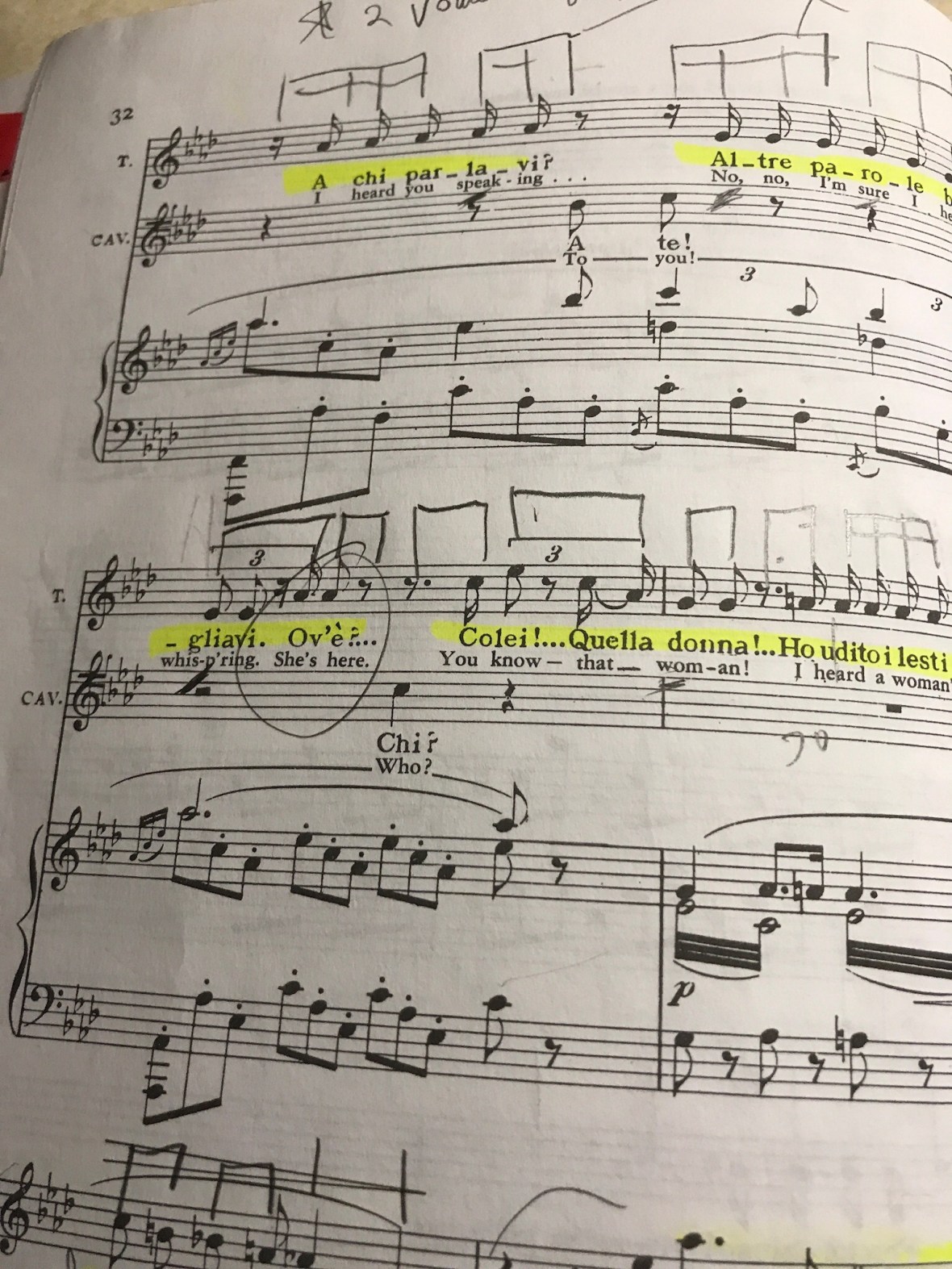
1. The Italian language in this role ain’t for the faint hearted. “Potessi coglierli i traditori” is quite the mouth and tongue-ful. Me Midwest mouth no like. 

2. Gathering the embouchure sure makes life easier with this role. 

3. Somewhere along the line, I became portamento phobic. Tosca is setting me straight and bringing me back to the light.  I think Puccini must roll his eyes every time he hears a dry rendition. 

4.  Tosca’s temperament takes my 21st century serenity minded self some time to access. It definitely pushes me to where I need to go as a singer. Ole girl could have benefitted from anxiety and anger talk or chemical therapy. LA CORONA! LO STEMMA! E L’ATTAVANTI!

5.  I’d probably relent with “Quanto? Il Prezzo” too for a fetching tenor who sings the crap out of E Lucevan. 

#akintsucrooner

A Singer’s Oy Vey :-D

You know you are working with the right person on your musical craft when they calmly help you fix phrases (after some laughter) where you have accidentally said “oh vey” instead of “o’ve” a few times. Or they help you understand why and where your legato goes awry and how to most efficiently produce double consonants with the most native tongue. It ain’t easy to find people who care about you as well as share their knowledge.  This teacher is very grateful for her teachers along the way.  #amorbernlina

img_6233

A Singer’s Ctrl+Alt+Del

Ctrl+Alt+Del:   A Singer Reboot

Blog by E. Perryman

#akintsucrooner

Clear Alt Delete

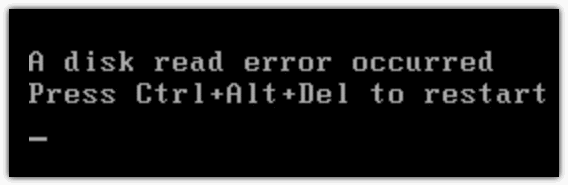
Ctrl+Alt+Del:  An electronic reboot that interrupts or facilitates interrupting a computer function.

What is the Ctrl+Alt+Del for life?  In particular, singing?

I find it interesting that control is the first word for this virtual eraser.  Does the computer become overwhelmed by our human interference?

Where else do we need this magical reset aka “3 finger salute?”

I worked with my voice student today, my talented wife Elizabeth, on finding her control alt delete function.  In other words, stop “singing” and find your fresh voice.

Alas, this is easier said than done.  Especially since it is important to have a tool bag of technique that is tailor made for you but invisible as you make sound.

So, I was inspired to write down some of the Ctrl+Alt+Del functions (below) that are useful in vocal production based on discoveries students and I have made together.  There are many sizes and one size most surely doesn’t fit all.

  1. FIND YOUR BLAH:  Say what?  Many of us try to control our sound by “setting” the sound and holding the tongue just so.  So it worked freely once?  Then we try to calcify that sensation so we always “have” it.  The hard part about singing is you don’t always wake up with the same throat on a daily basis.  When I was in college especially, on occasion, I would try to talk myself into not going to sleep out out of fear of waking up dysphonic.  There’s nothing like waking up with an unhappy voice and paying gig performance ahead of you that night.  I have worked over these past 30 years of instruction to find various tools to help me always find my free sound no matter the condition of a fickle throat.  Truth is, you can’t really hear your sound accurately if you are singing freely.  You need a physical reset button that doesn’t rely on listening to yourself.   If you want to hear yourself, play an instrument, so the saying goes.  Your blah can be a personal release and your best pal.  It will help your tongue and neck become un-involved. It is scary to forego the “control” of the neck and tongue but essential.
  2. STOP DROP & ROLL:  All the pithy things your voice teacher is imparting in their “great wisdom” can make you feel like you are swimming upstream through your brain matter.  Your throat is tense, your mind is racing, and you feel like a fraud.  Stop the exercise, drop down to a rag doll position, and roll your body around as your body releases.  When you come back up try to do the exercise again and see what comes out of your mouth.  Most of my students, myself included, are pleased with the results.  I usually ask  “How did it feel?”  The typical response is “it just came out.”  Even if your teacher looks at you like you have 3 heads when you employ various re-set strategies, don’t be intimidated.  Use your resources and carry on.
  3. IF IT AIN’T BROKE:  In short, find your most efficient vowel.  Are you like me and you can find yourself in an Ah-less singing land?  My wonderful Italian coach, Giovanni Longo, deserves a tip every time he needs to remind me to sing an internal ah vowel and match AHS to each other.  It would be a very lucrative endeavor if he decided to implement this approach. 😉 So take what works organically and migrate the sensation into the other vowels.
  4. USE THE TRAP DOOR:  What type of consonant or melodic approach leads you to the promised land?  I LOVE the unvoiced F and imma a melodic leaper.  If I am having difficulty with a phrase and need to reset, I add these magical door release hinges.   It helps me re-anchor into my breath support and get out of my own head.

Singing is as much a mental as a physical exercise.  There is theoretical work to be done, sheer physical routining, implementing of optimal singing conditions, and sometimes a needed therapeutic conversation with yourself and/or trusted colleague/teacher.  Find your personalized Ctrl+Alt+Del and let it reset and invigorate. #kinstucrooner

May you find deep peace,
May you feel loved and be loving,
As you inhabit the sacred jewel of your own life.

Holding on is believing that there’s only a past; letting go is knowing that there’s a future.

Daphne Rose Kingma